
The U.S. Navy SEALs are the U.S. Navy’s primary special operations force and a component of the Naval Special Warfare. The first training that SEALs undergo is a six-week sorting out process that culminates with the final hell-week. During the hell-week, the SEALs spend a lot of time being cold and wet, and get just four hours of sleep over a sixty hour period.
Years ago, the U.S. Navy was facing a problem of high attrition of almost 75 percent during the first six-week training that SEALs are put through. This was surprising, since the SEAL candidates are carefully selected based on high IQs and excellent physical conditions, and are able to perform all the activities required of them.
The Navy hired Eric Potterat, a clinical and performance psychologist to find out what could be done to increase the ability of the candidates to persevere without quitting. Potterat came up with the Big 4 Critical Habits that may mean the difference between life and death, and by training the SEAL candidates in these four habits, the retention of candidates increased by 50 percent. These habits can be used by anyone to persevere in any endeavor without quitting when facing adverse conditions, stressful situations, or, when performing difficult tasks.
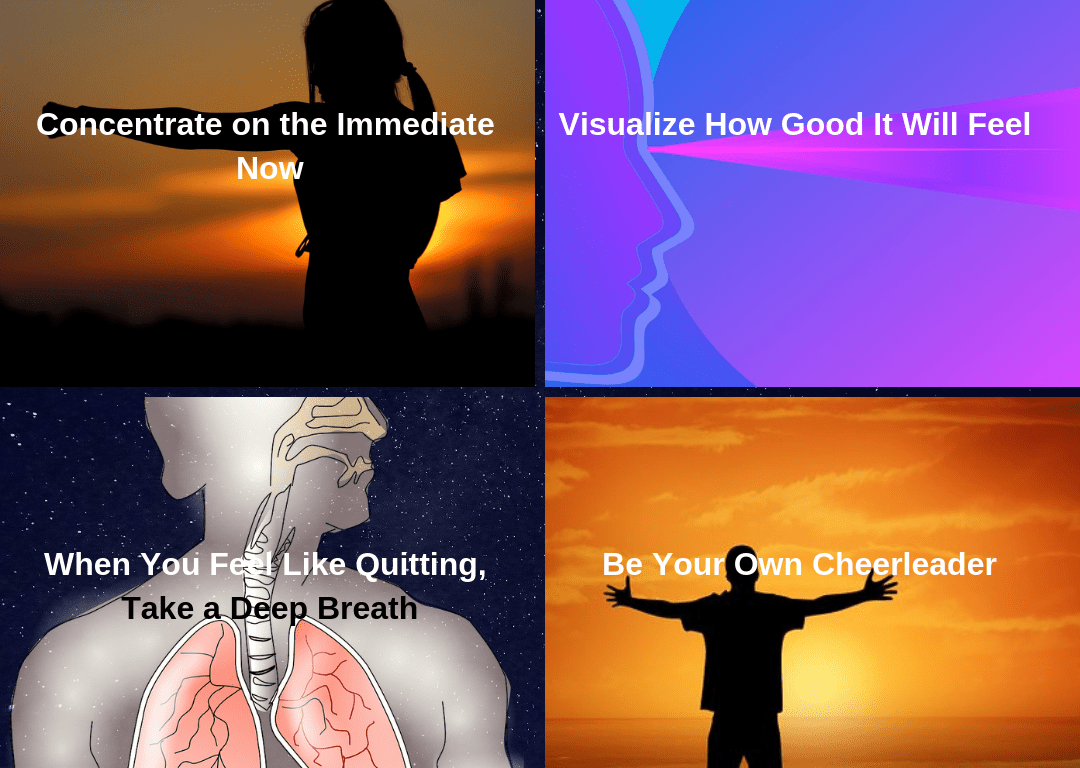
Habit 1: Concentrate on the Immediate Now
Narrow your focus down to the “immediate future” with respect to the task on hand without thinking about anything after that. Do not think about the next steps, the results and what-ifs. This state is known as “mindfulness” or “Mushin”, a Zen state of mind.
You would dare not look at the top of a steep hill, if your mission is to reach the top on a bicycle, for it is likely to discourage you. Instead what will work well is to look just immediately ahead, and turn the pedal over once, and crank it over again, and again, and again.
Habit 2: Visualize How Good It Will Feel
Rehearse in your mind’s eye all of your past successes. As you go through your success list, pay attention to your feelings. Your feelings may be one of accomplishment, of being capable, of elation.
Now, you take those feelings and visualize what you will feel when you successfully do the thing you are doing now. Tell yourself how good it feels to have taken the first step, to be making progress and to be completing the task. Every time you finish a task or a sub-task, you check it off your check-list. This is a very powerful technique; one that uses the power of visualization, association and transference to keep you encouraged and provides you the inner motivation to persevere.
Habit 3: When You Feel Like Quitting, Take a Deep Breath
Sometimes, things don’t go well, and they will. In such a situation, you are likely to feel discouraged and demotivated, and a panic reaction sets in. The panic reaction is due to anxiety about the future. It is a primal reaction caused by “amygdala”, an almond shaped set of neurons located in the brain, which determines when you are safe and when you are not.
The best way to beat the panic reaction is by changing your physiology – your current physical position – and breathing deeply. When you breathe deeply, your body is flooded with oxygen, which changes your blood chemistry, calms down the amygdala and increases your ability to think and react thoughtfully. Inhale deeply for a count of six, hold it for a count of two, and then exhale for a count of six completely emptying your lungs. Do this three to five times when you feel panic reaction setting in.
Habit 4: Be Your Own Cheerleader
When we feel frustrated, anxious, and fearful, we hear voices in our heads that are discouraging and dis-empowering. This is natural, and happens as if on auto-pilot. You have to learn to become aware of the voices in your heads.
Instead of allowing the dis-empowering thoughts, you have to train your mind to deliberately list everything that feels good and constantly cheer yourself on while in the process of doing whatever you are doing.
 Giridharan S — Living the Paradoxical Life and Guiding Others Through It