
Thirty spokes converge upon a single hub; it is on the hole in the center that the use of the cart hinges.
Shape clay into a vessel; it is the space within that makes it useful.
Carve fine doors and windows, but the room is useful in its emptiness.
The usefulness of what is depends on what is not.
-Lao Tzu
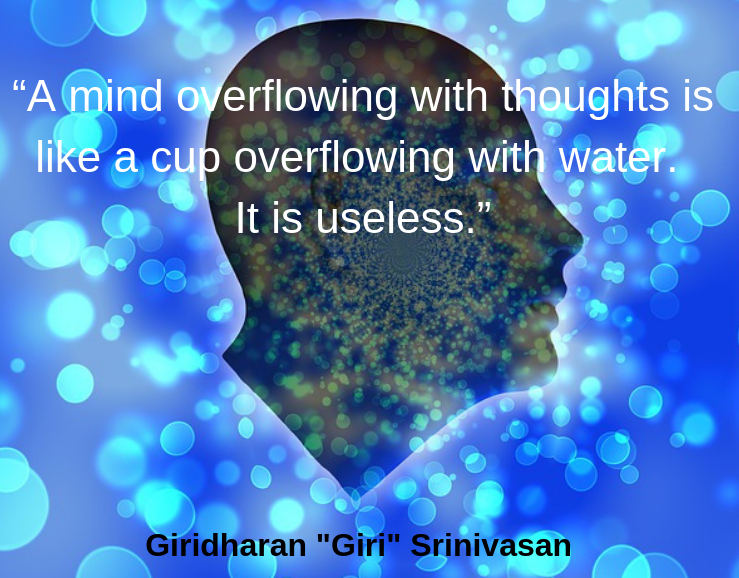
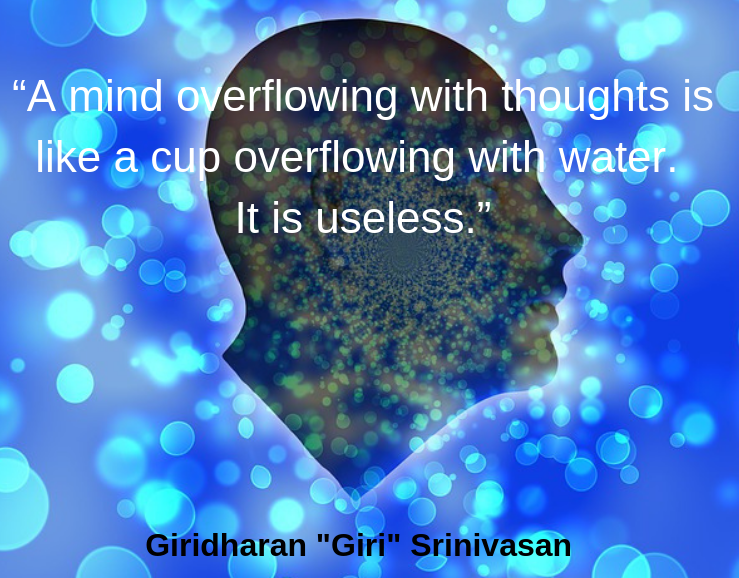
When your mind is overflowing with thoughts constantly, it does not serve any purpose. There is no real learning, and you are not performing to your fullest potential.
Real learning and growth happens not by occupying your mind with past events, or, worrying about the future, but by cultivating a state of beginner’s mind (“shoshin” in Japanese), and no-mind (“mushin” in Japanese).
A beginner’s mind (shoshin) is a ready mind, open to everything and attached to nothing. It is without any preconceived notions or bias. As the famous Zen monk Shunryu Suzuki is known to have said, “In the beginner’s mind there are many possibilities, but in the expert’s mind there are few.”
The state of no-mind (Mushin) is to be in a state of complete awareness and mindful of the present moment. This is the highly focused mental state known as “flow”, or the psychology of optimal experience, coined by the psychologist Mihaly Csikszentmihalyi.
Have you considered the usefulness in emptiness?
 Giridharan S — Living the Paradoxical Life and Guiding Others Through It
You must be logged in to post a comment.